
AI Is Changing How We Work. Why Not Financial Crime Investigations?
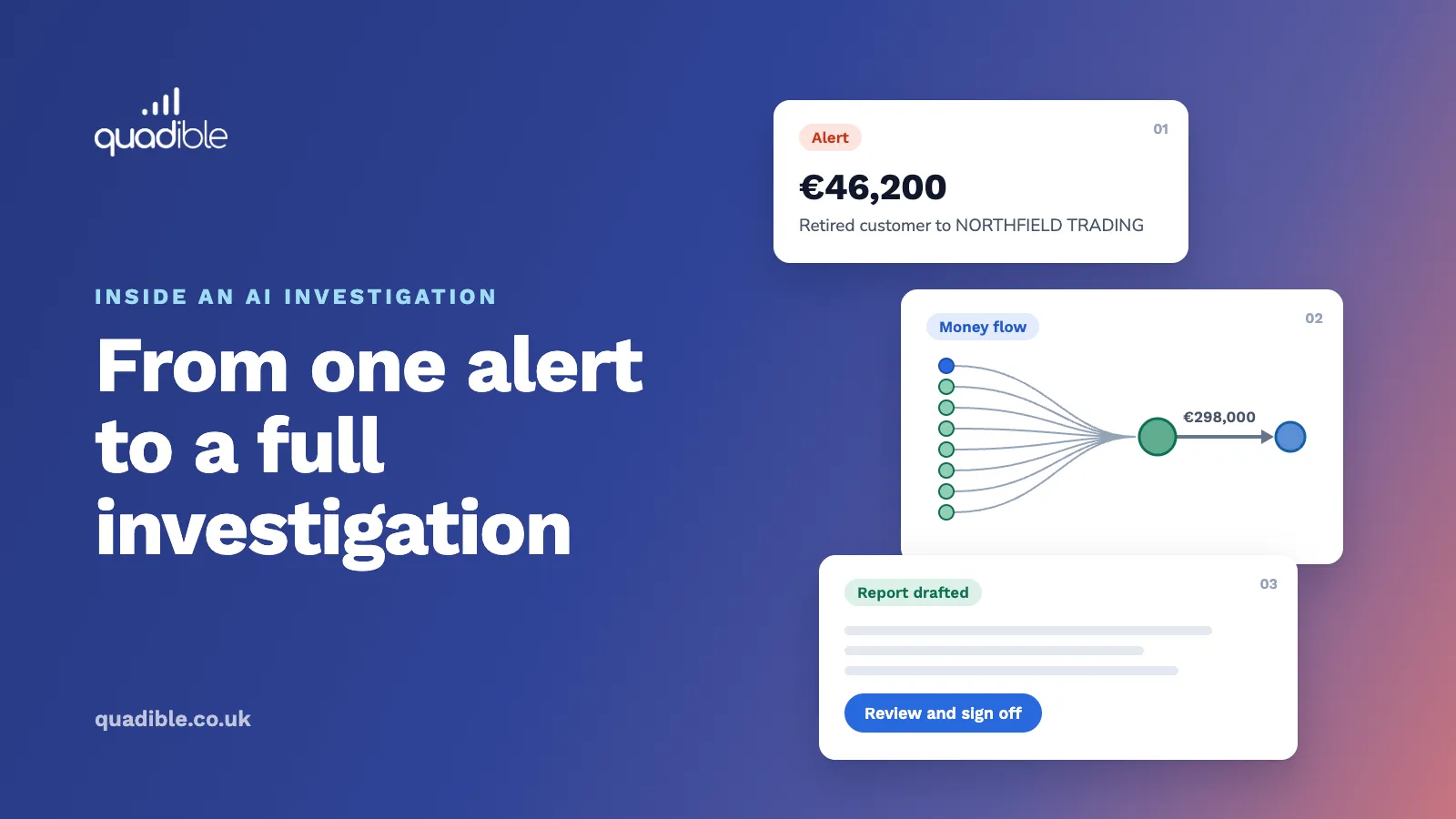
AI is changing how we work. Developers build software with AI agents. Professionals use them to research, analyse information and complete tasks that once required hours of manual effort.
Yet in many banks, financial crime investigations still look remarkably familiar: analysts switching between systems, collecting transactions, tracing relationships and assembling reports by hand.
What if investigators could work with AI agents, too?
That’s exactly what Quadible’s AI Investigators are built to do.
To see what this looks like in practice, let’s follow a single AML alert through an investigation, from the first suspicious transaction to an evidence-backed report.
The following case uses fictional customers and synthetic data in a demonstration environment.
1. One alert. Several unanswered questions.
A bank’s transaction monitoring system flags an unusual payment.
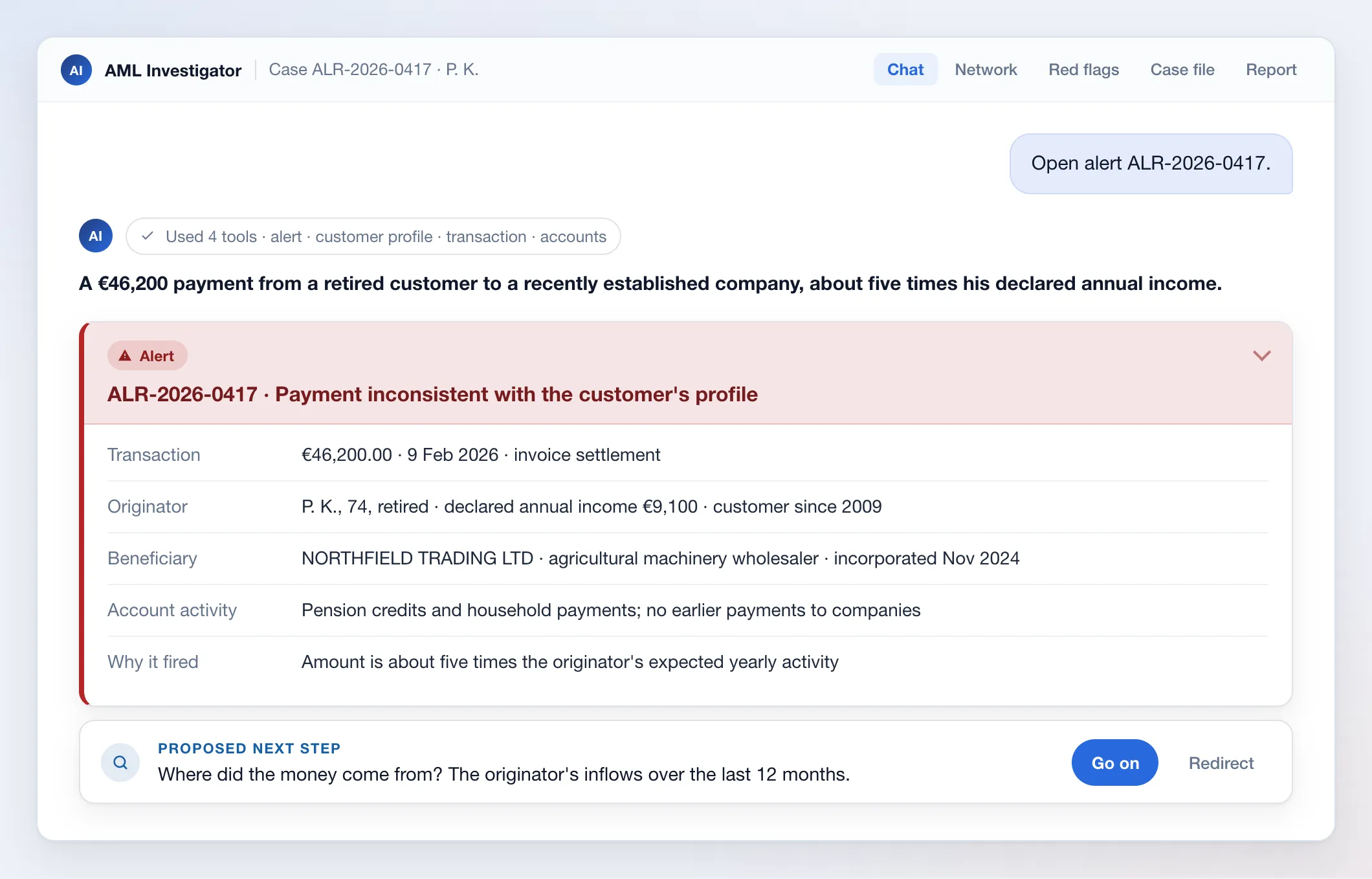
€46,200 has been transferred from the account of P. K., a retired customer with a declared annual income of €9,100, to NORTHFIELD TRADING LTD, a recently established agricultural machinery wholesaler.
The transaction is inconsistent with the customer’s known financial profile. But an unusual transaction is not, by itself, evidence of money laundering.
The analyst opens the case in Quadible’s investigation workspace.
The AML Investigator brings together the alert, customer profile, transaction details and relevant account information. It explains why the transaction warrants attention and proposes the first line of enquiry:
Where did the money come from?
The analyst chooses to investigate further.
2. Following the source of funds
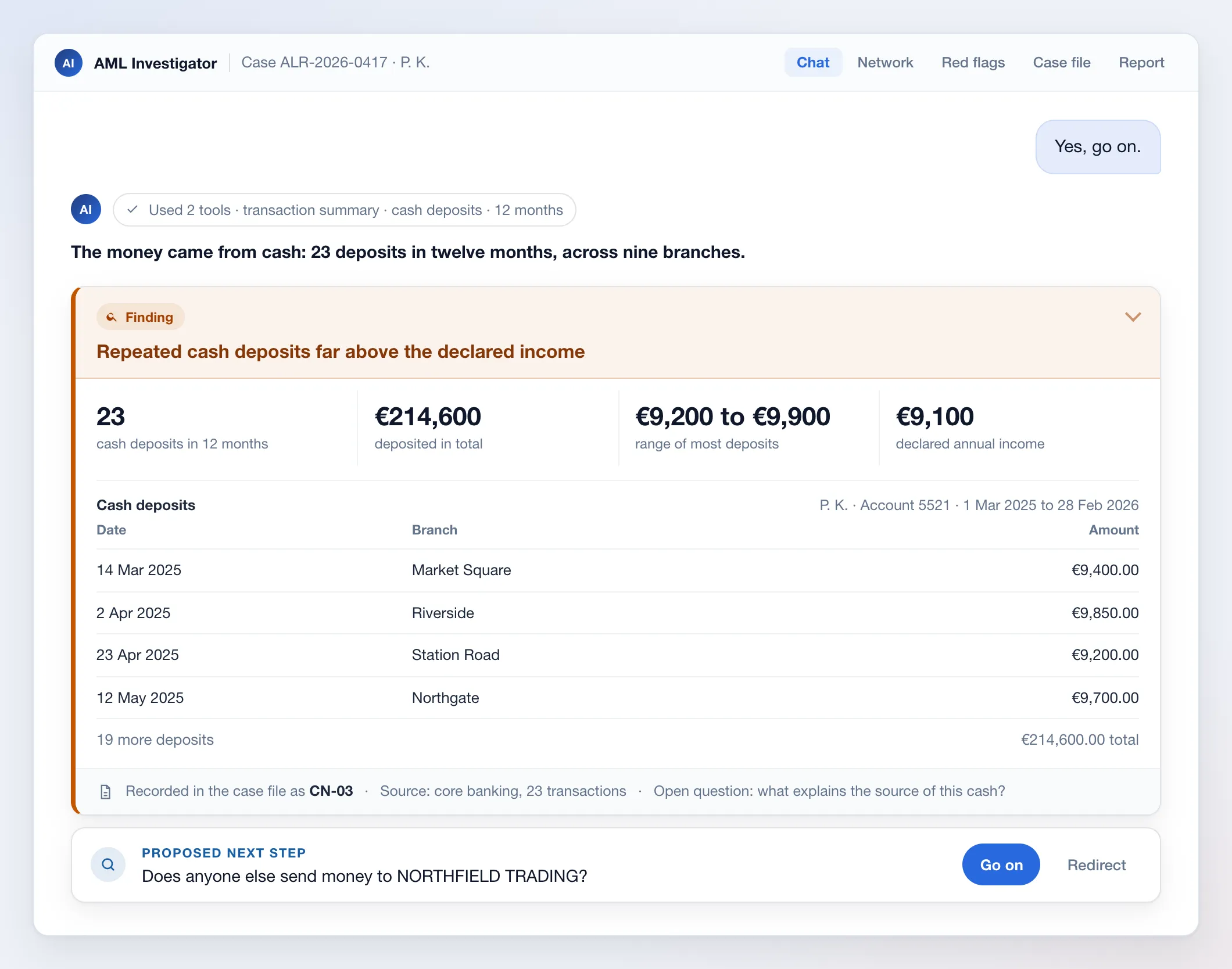
The Investigator retrieves twelve months of account activity and identifies a pattern that wasn’t visible in the original alert.
The customer has made 23 cash deposits totalling €214,600, across multiple branches. Most deposits are between €9,200 and €9,900, unusually high amounts relative to the customer’s declared income.
The Investigator highlights the pattern, records the relevant transactions and identifies the unanswered question: what explains the source of this cash?
Crucially, the finding is not just another paragraph in a conversation. It becomes part of the case record, linked to the underlying transaction data.
The analyst can inspect the evidence, challenge the interpretation or direct the next step.
3. From an isolated transaction to a connected network
The analyst asks whether other customers have sent money to NORTHFIELD TRADING.
The Investigator expands the search.
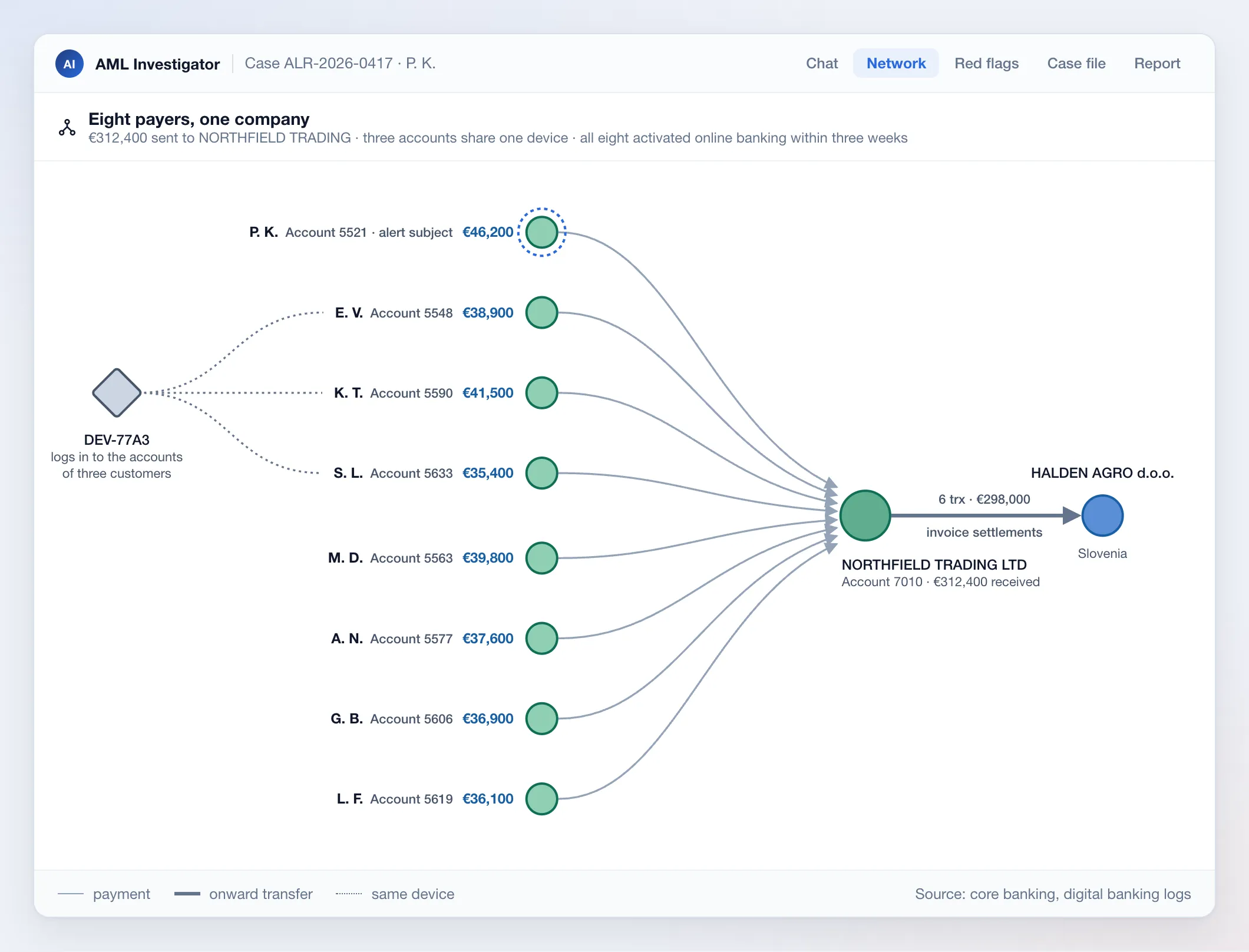
Across eight customer accounts, it identifies €312,400 in transfers to the same company. Several payers have modest declared incomes, raising questions about the origin and purpose of their payments.
The investigation then connects transaction data with digital banking activity.
Three of the accounts have been accessed using the same device. All eight activated online banking within a short period.
Individually, these observations might be difficult to interpret. Together, they warrant further investigation.
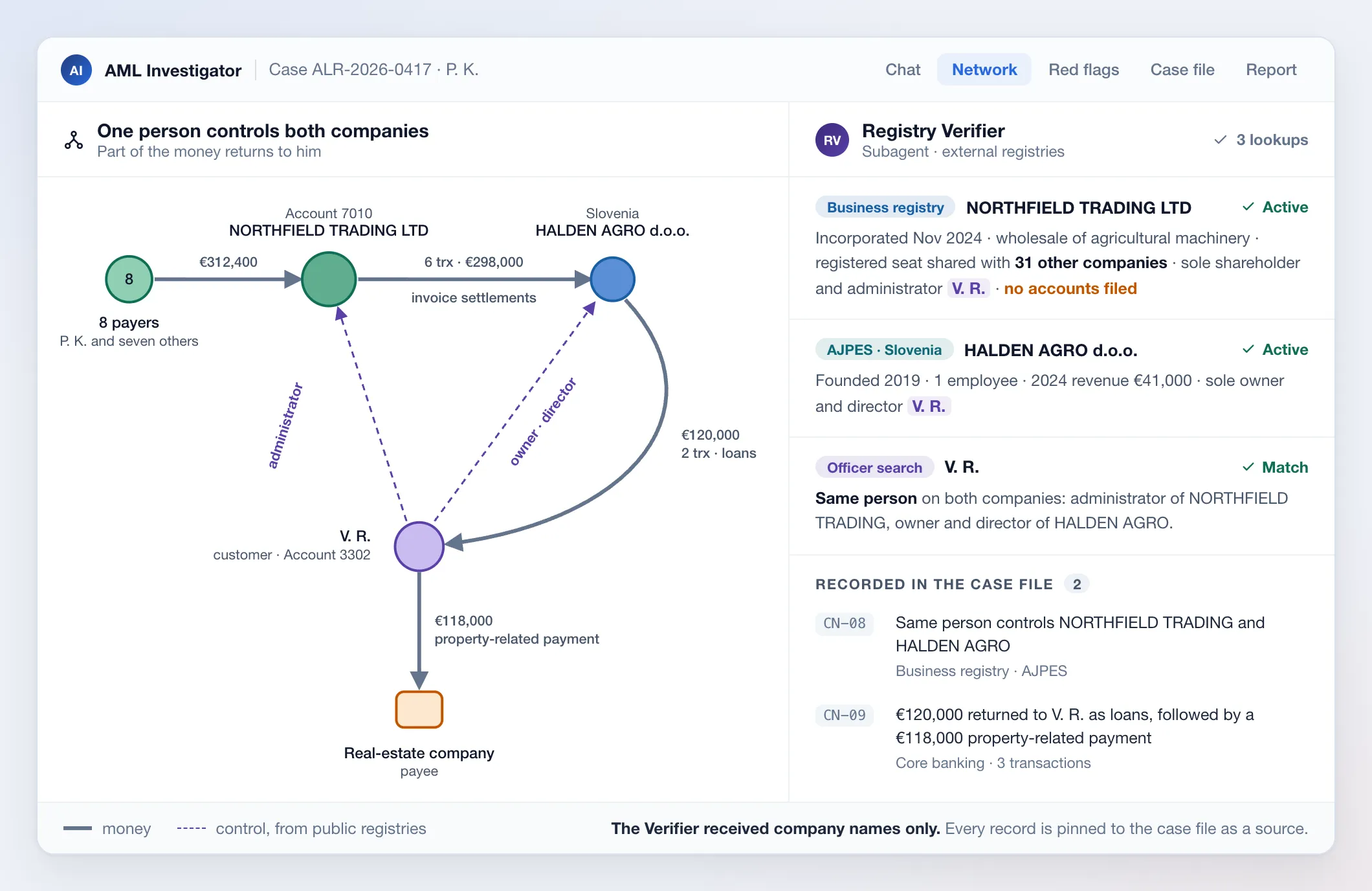
The Investigator builds a visual network connecting the accounts, shared device and beneficiary company.
The analyst can now see relationships that would otherwise require switching between multiple banking systems and manually comparing records.
The analyst follows the money beyond the beneficiary.
Of the €312,400 received, €298,000 was transferred to HALDEN AGRO, a company registered in Slovenia, with payments described as invoice settlements.
The investigation has moved beyond one customer’s unusual payment. It now concerns a network of related transactions, accounts and companies.
4. Investigating the companies behind the transactions
The next question is whether NORTHFIELD TRADING and HALDEN AGRO have a legitimate commercial relationship.
The Investigator uses a specialised Registry Verifier to retrieve company information from external registries.
The records reveal an important connection: both companies have the same owner and director.
Further examination of available banking records shows transfers from HALDEN AGRO to the controller’s personal account, described as loans, followed by a property-related payment.
These are significant observations, but they still need to be evaluated in context.
The Investigator assembles the information into a connected view, showing how funds move between customers, companies and individuals.
Throughout the process, each finding retains its supporting source.
5. From suspicious patterns to an evidence-backed case
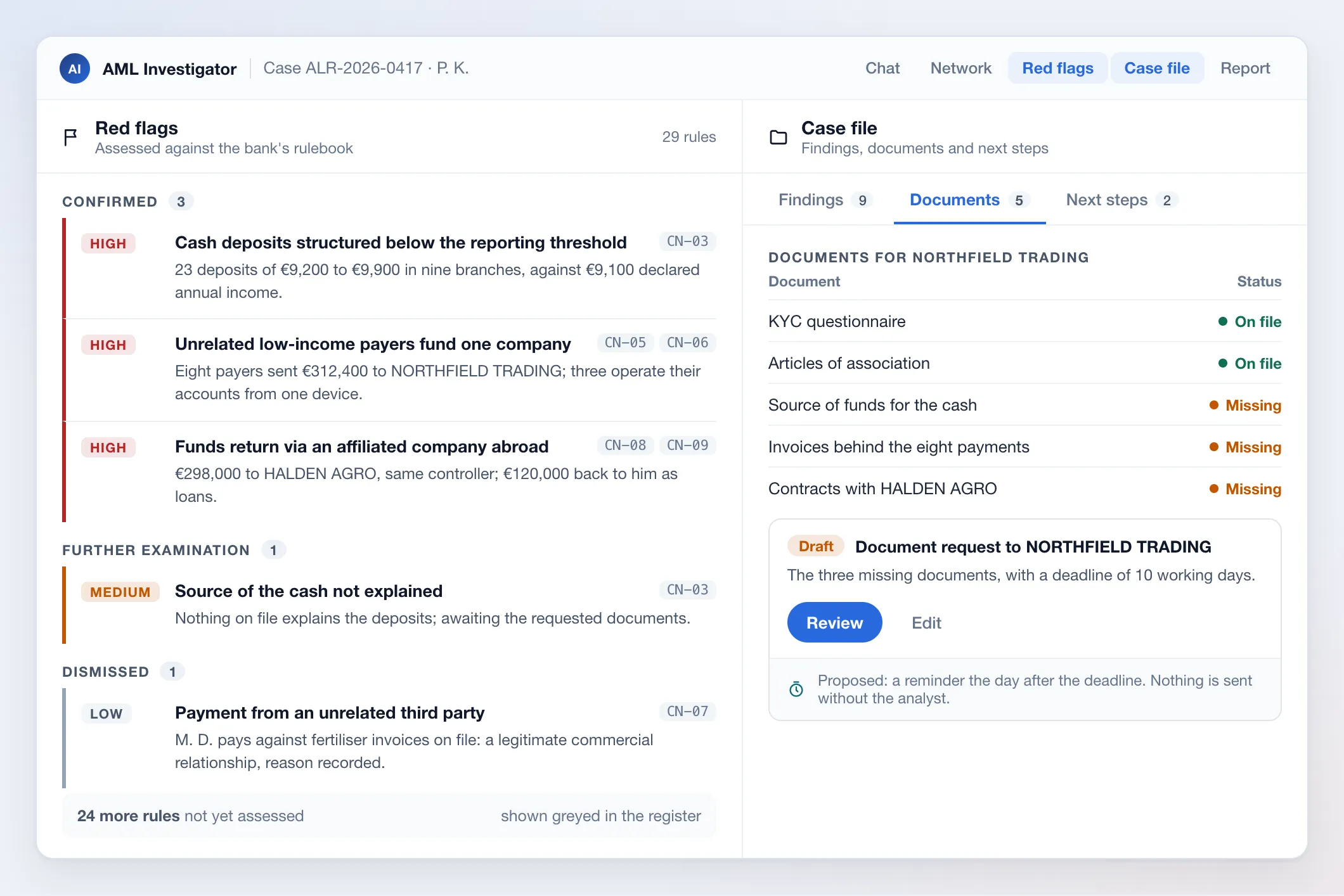
Identifying patterns is only part of an AML investigation. The analyst also needs to determine which concerns are supported by evidence, which require further examination and which can be dismissed.
The Investigator evaluates the available information against the bank’s configured rules and investigation procedures.
The analyst can review the resulting red flags, inspect the supporting evidence and reassess any conclusion.
For example, an apparently suspicious payment may turn out to have a legitimate commercial explanation. That explanation needs to be recorded just as carefully as a confirmed concern.
The Investigator also examines the documents already held by the bank.
Where supporting information is missing, it can prepare document requests and follow-up actions for the analyst to review.
The result is a structured case file containing findings, relevant transactions, connected entities, documents and unresolved questions.
6. A report built from the investigation, not from scratch
Once the analyst has reviewed the findings, they ask the Investigator to prepare a report.
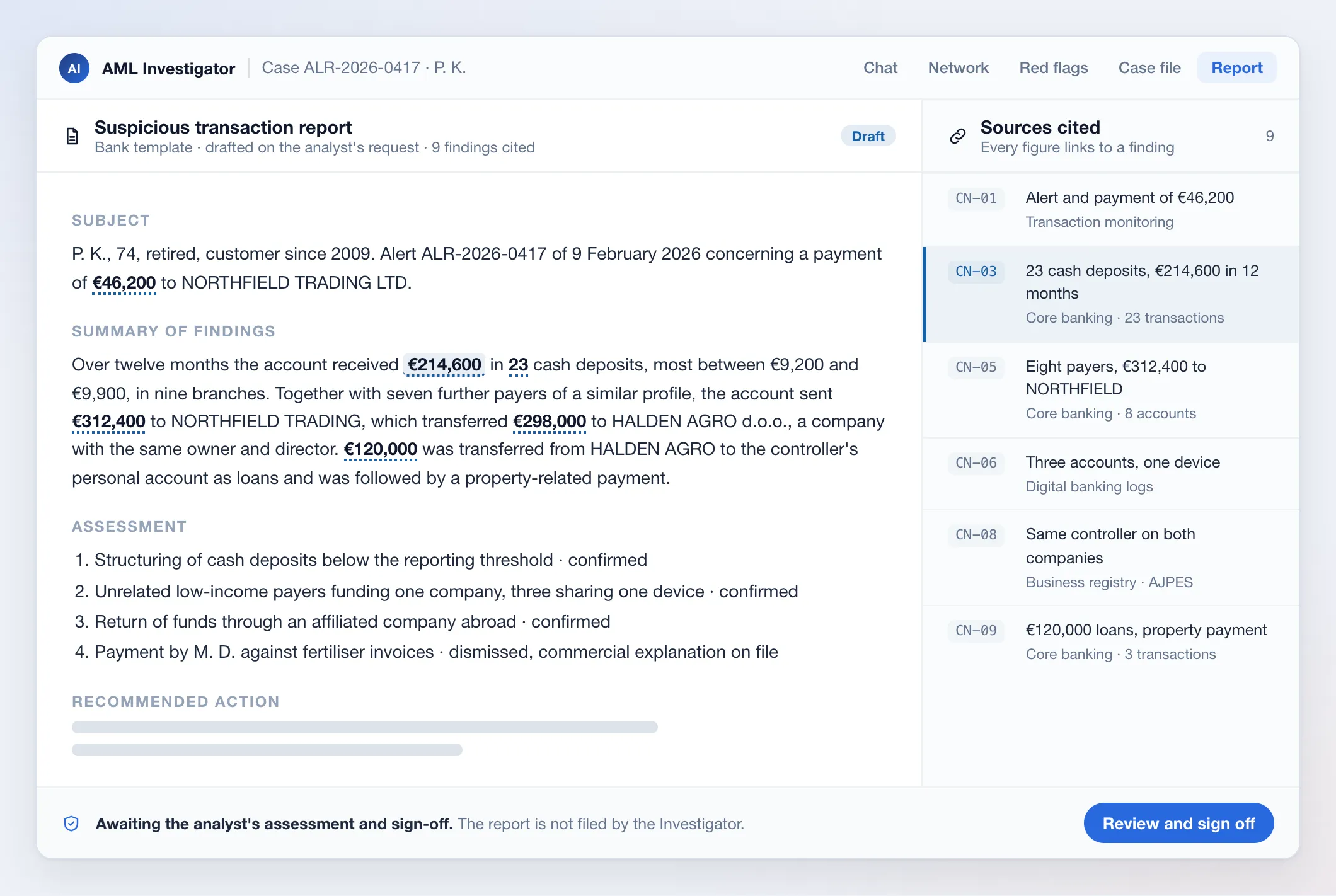
The Investigator drafts the suspicious transaction report using the bank’s template and the evidence collected during the investigation.
Amounts, counterparties, dates and conclusions are linked back to the underlying case findings and supporting records.
Instead of manually reconstructing the investigation in a separate document, the analyst starts with a structured draft that can be checked, edited and completed.
The analyst remains responsible for the final assessment and decision. The Investigator prepares the evidence and documentation; it does not independently file the report.
What changes for the investigator?
The difference is not simply that an AI system can answer questions about transactions.
It’s that the Investigator can work across connected data sources, follow investigative leads, maintain a structured record of evidence and help prepare the documentation needed to support a decision.
For the bank, this means less manual information gathering, more consistent investigations and better use of analyst capacity.
For the analyst, it means spending less time navigating systems and assembling documents, and more time evaluating what the evidence actually shows.
Detection has been automated for years. Now investigation can benefit from AI, too.
Quadible’s AI Investigators work with existing AML and Fraud systems, combining automatic alert prioritisation with analyst-directed investigations.